
Harmonia: Who is She?
Harmonia is, as you’ve probably guessed, the Ancient Greek goddess of harmony and unity.

Harmonia, as seen on a Late Classical calyx krater currently in the Louvre.
Harmonia is also the daughter of the god of war, Ares, and the goddess of love, Aphrodite. Her connection to both war and love makes her a living embodiment of tolerance and intersectional identities.
Why does this perfectly define what I wish to do with Harmonia Animal Training?
There are so, so many connections I could make. For one, my ancestry is Greek, specifically from the area just north of Ancient Sparta — a settlement which worshiped primarily Ares and Aphrodite.
Harmony is also exactly what I have personally sought my whole life (and I am sure most or all of you have, too). Harmony does not mean erasing the “undesirable” parts of ourselves, but working to balance it with the “desired” parts. Anger gives way to justice, as fear gives way to growth. Would you have ever overcome a phobia if you’d not felt that fear in the first place? Would you have ever accomplished something you’re passionate about without that passion to fuel you?
Dogs are not exempt from this. They feel emotion stronger than any human, because they do not have the higher thinking we do — they feel things in their purest and simplest form. There are always straightforward reasons for an anxious dog, and there are always explanations for their acting out. If your child throws things or breaks a toy, they could be feeling any slew of strong emotions; if your dog chews up a pillow, they are bored. Not spiteful, not annoyed with you in particular. Just the emotion itself.
Following the philosophy of the goddess of harmony, I do not wish to “fix” your dog’s problem behaviors. Hear me out.
You have been at work all day, and come home to your dog having knocked over the trash can, and now last night’s dinner is spread across the floor and your dog is sitting in the midst of it, proud of themselves. You shout at your dog, because it has been a very long day, and you haven’t even made yourself dinner yet. Your dog hangs its head and stares with those huge, completely innocent eyes. Now you have to clean up this mess, and your dog trots out of the room to hide somewhere.
Where’s the harmony in this situation? Here’s an alternative.
Before you leave for work in the morning, you make sure the trash is under the sink, out of reach. Since it is a long day, you set up an area for your dog — maybe a room, or maybe their crate — and give them water and a dark place to rest. Once you get home from work, you let them out right away and bring them back inside to chew on a bone or lick a Kong while you cook yourself dinner. Maybe your dog is still pent up and energetic, and you’re exhausted. So you get a cardboard box from the garage, toss a few desired treats in there, and either tape it shut or fold it up a bit more. Now your dog can destroy something and feel fulfilled, and you can eat your spaghetti and meatballs in peace.
Does this second option sound better? It does for me. The mess you have to clean up — the cardboard box — is something that was trash anyways, and it is minimal when compared to a trash-can’s-worth of mess.
I understand this is all anecdotal. So I want to further break down why this second option is better for you and your dog.
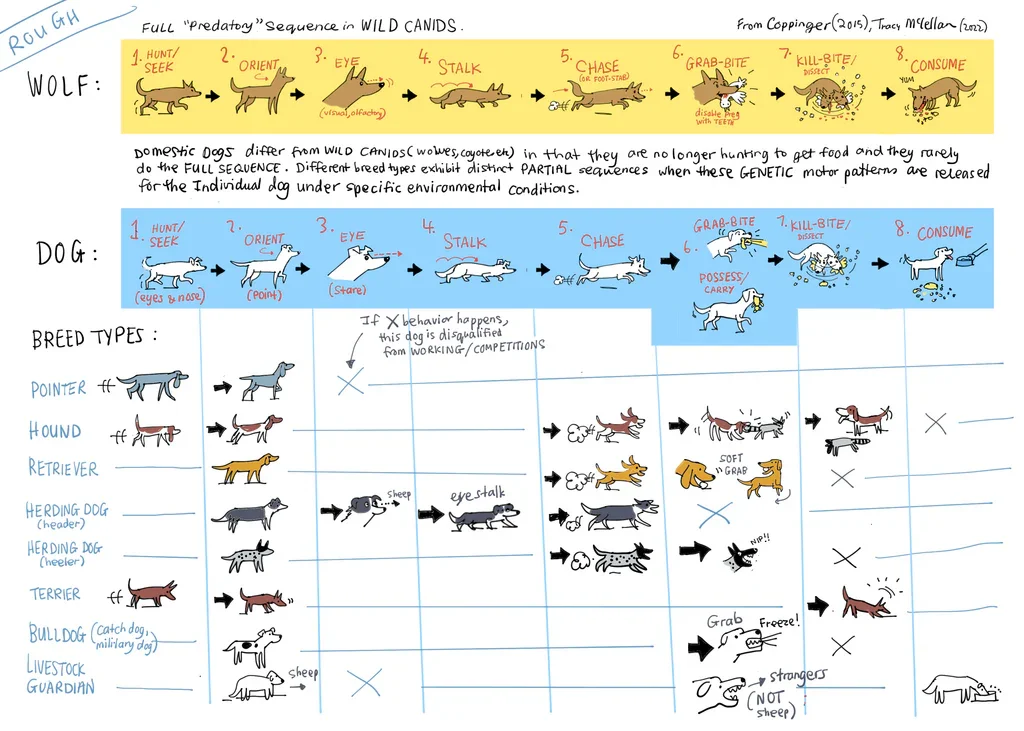
All dogs are predators. They, along with wolves and wild canines, have something called a predatory sequence. (Picture below). However, modern dogs don’t typically get to indulge in the “dissect” stage of this, because they are not still hunting rabbits through the woods with ancient humans. What I mean to say is this: All dogs want to destroy something. If they aren’t supplied with something to destroy — i.e. a cardboard box, chew toy, rope, old socks full of holes — they will find something to destroy. And you probably won’t like what it is.
All dogs like a peaceful place to rest. I will sound like every other trainer when I say this, but crate train your dogs. If it has made you feel bad, or all they do is cry, then it must be made into a place they want to rest — it hasn’t been comforting enough for them before. Cover it with a blanket. Keep a bowl of water inside. Make it roomy. (Avoid keeping things they could choke on inside, like toys). Ever seen a husky or shepherd or hound dig a big hole just to sit in it? Canines like to sleep in caves. It’s dark and peaceful. Give them a cave.
All dogs seek stinky smells. They’re hunters; it’s in their nature. If you have a big, stinky can of trash, that looks like a full-course buffet to your dog. Despite their desire for it, onions and garlic and other popular human foods are dangerous for them. Instead, get a Kong or lick mat or even smear some peanut butter on your floor if you don’t mind cleaning it up after. Find them something stinky to get into, or they‘ll find something for themself.
Dogs often don’t understand when they’ve made a huge mess. Yelling at them for getting into the trash can or chewing up a pillow typically just confuses them, especially when they’ve been waiting all day to see you. Like a baby, they don’t yet understand why they cannot throw things around or tear things up.
Allowing your dog to truly be a dog is harmony; allowing your dog to be a dog whilst still being a good roommate is the meaning of Harmonia.